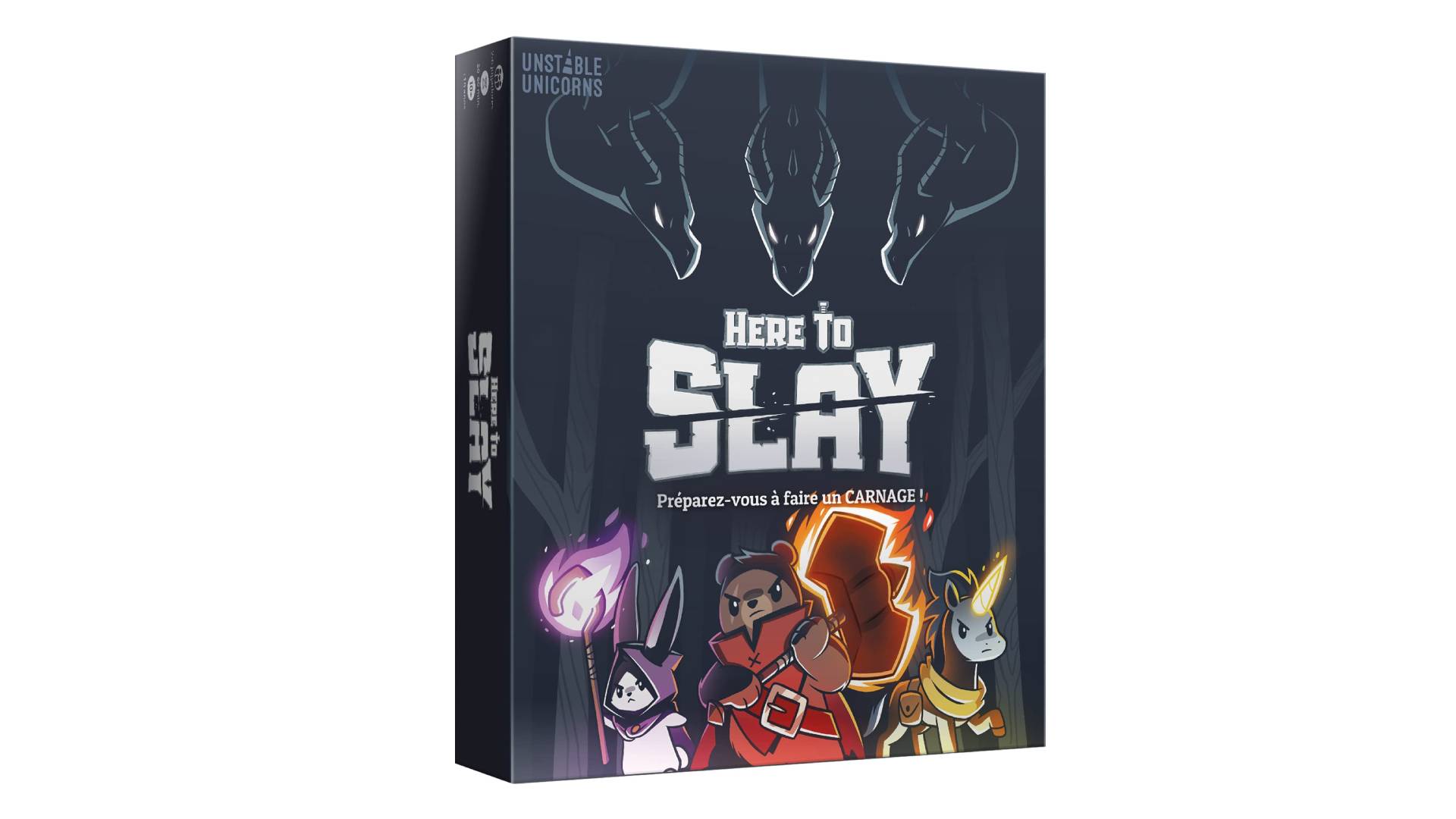
Here to Slay Rules
Here to Slay is a competitive role-playing card game where players assemble a party of Heroes to slay dangerous Monsters. Equip items, cast powerful spells, use roll modifiers, and challenge your opponents. The first player to slay three Monsters or assemble a full party of six different classes wins the game!
Last updated: Mar 2026
Introduction
Welcome to Here to Slay!
In this game, you'll assemble a full Party of Heroes to slay dangerous Monsters while working to avoid the sabotage of your friends (enemies). You'll also equip items to your Heroes, harness powerful magic, and use roll modifiers to tip the odds in your favor.
The first player to slay three Monsters, or assemble a full Party with six different classes, wins the game!
A typical game of Here to Slay takes approximately 30-60 minutes to complete.
What's in the Box
Inside the box, you'll find the following components:
- 1 main deck (115 standard-sized cards)
- 6 oversized Party Leader cards
- 15 oversized Monster cards
- 6 rules reference cards
- 2 six-sided dice
Setup
Follow these steps to set up the game:
- Separate the different types of cards in the box.
- Each player chooses a Party Leader character to represent them throughout the game. Place your Party Leader card in your Party (the play area in front of you). You may roll to determine who picks first, or just make it a free-for-all.
- Each player may take a rules reference card. Place remaining Party Leader cards and reference cards back in the box — they will not be used.
- Shuffle the standard-sized cards together, then deal 5 cards to each player.
- Place the remaining stack face down in the center to form the main deck. Leave space next to it for a discard pile.
- Shuffle the Monster cards and flip the top 3 Monster cards face up in the center of the table. Place the remaining Monster cards face down to form the Monster deck.
Whoever picked their Party Leader card last gets to go first. Players take turns going clockwise around the table.
How to Play
On your turn, you get three action points to spend. You can perform the actions below in any order, and you can perform the same action more than once if you have enough action points.
Actions Costing One Action Point
- DRAW a card from the main deck.
- Play a Hero, Item, or Magic card from your hand. If you play a Hero card, you may roll to use its effect immediately.
- Roll two dice to use the effect of a Hero card already in your Party. You cannot roll to use the same Hero card's effect more than once per turn, even if you roll unsuccessfully the first time.
Action Costing Two Action Points
- ATTACK a Monster card.
Action Costing Three Action Points
- DISCARD every card in your hand (if you have any) and DRAW five new cards.
Important: If a card's effect tells you to perform an action immediately, you do not have to spend an additional action point for that action.
Your turn ends when you have no action points left or you choose not to take any additional actions. Unused action points do not roll over into your next turn.
For details on each card type, see Card Types.
The Class Symbols
Each Hero and Party Leader card has a class. There are six classes in the game, each represented by a colored symbol:
- Fighter
- Guardian
- Ranger
- Thief
- Wizard
- Bard
A gray symbol on Monster cards denotes a Hero card of any class.
Some Monster cards require you to have a Hero or Party Leader of a certain class in your Party to ATTACK them. You can also win the game by assembling a full Party that includes all six different classes. See Monsters for attack requirements.
Card Types
The main deck contains five different types of standard-sized cards: Hero, Item, Magic, Modifier, and Challenge cards.
Hero Cards
Your Heroes are brave adventurers. Each Hero card has a class and an effect with a roll requirement. To use a Hero card's effect, you must roll two dice and score equal to or higher than that roll requirement.
- When you play a Hero card from your hand into your Party, you may immediately roll two dice to use its effect.
- Once a Hero is in your Party, you may spend one action point to attempt to use its effect once per turn. If you roll unsuccessfully, you do not get the action point back.
- There is no limit to the number of Hero cards you can have in your Party.
Item Cards
Item cards are enchanted weapons and objects that can be equipped to your Hero cards. Most Item cards bestow positive benefits such as bonuses to rolls or protections.
- When you play an Item card, you must immediately equip it to a Hero card by sliding it underneath the Hero card with the text still showing.
- Item cards can only be equipped to Hero cards (not to Party Leader cards).
- Only one Item card can be equipped to a Hero card at a time, and you cannot replace one Item card with another.
- If a Hero card with an equipped Item is destroyed, stolen, or returned to your hand, the Item card goes with it.
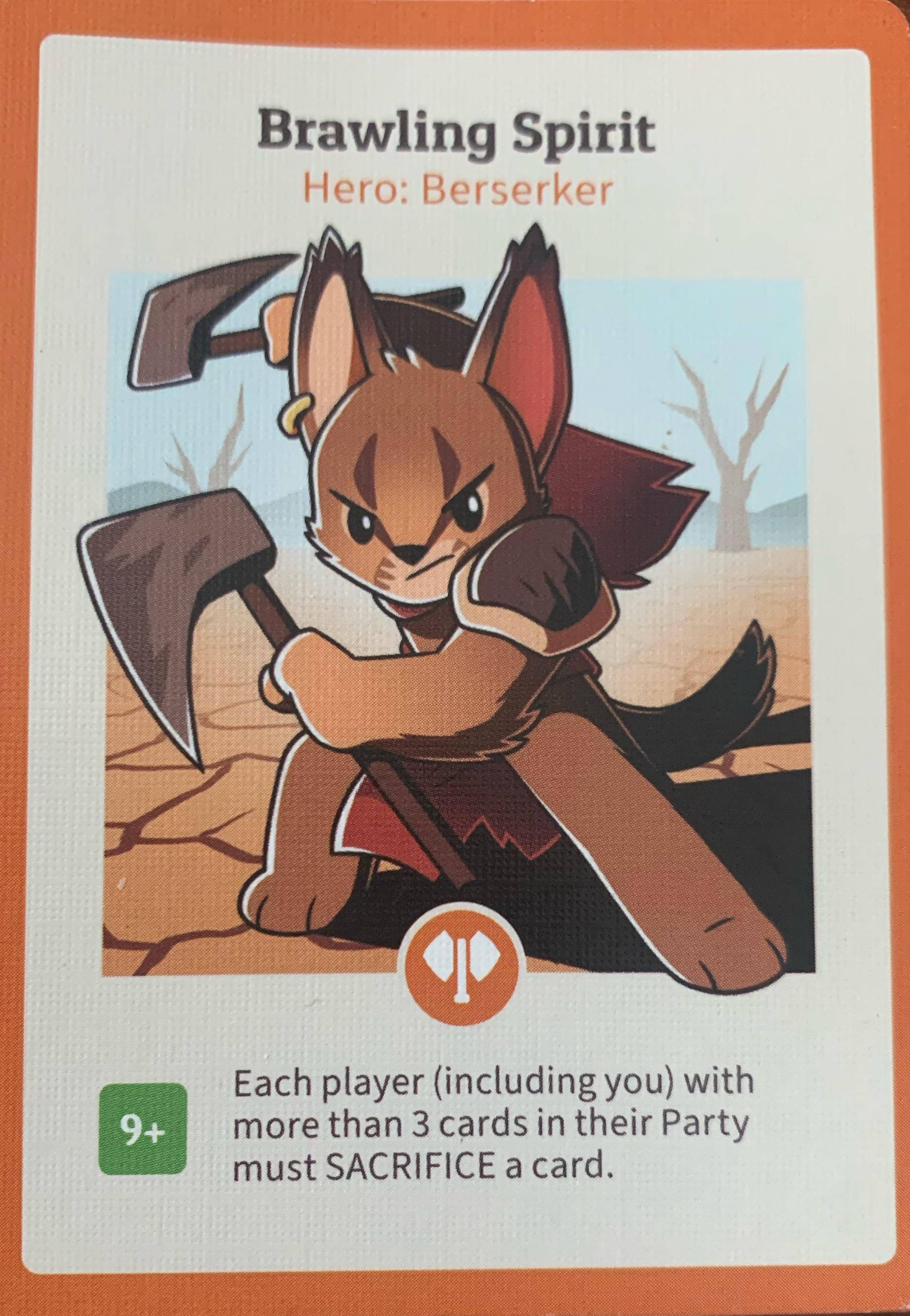
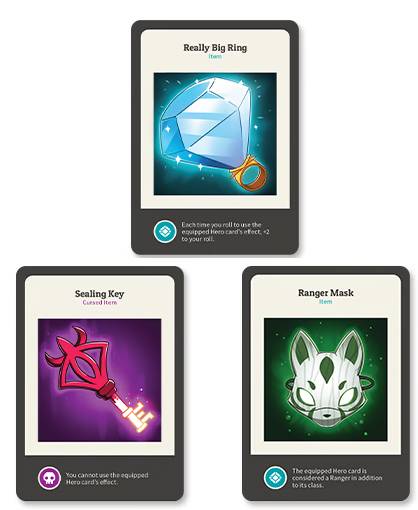
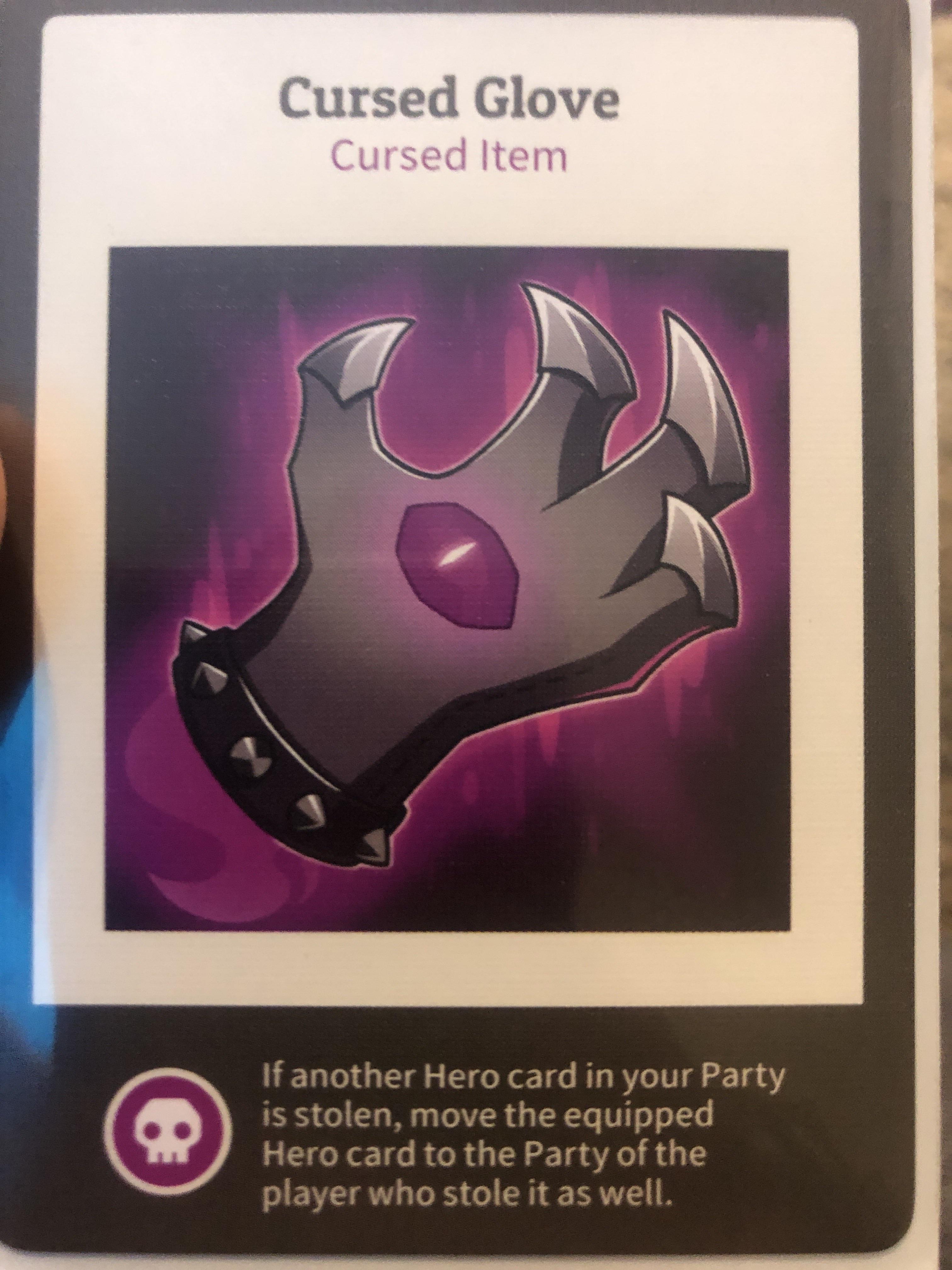
Cursed Item Cards
Some Item cards are Cursed Items that provide negative effects. These can be equipped to enemy Hero cards to give them disadvantages.
Magic Cards
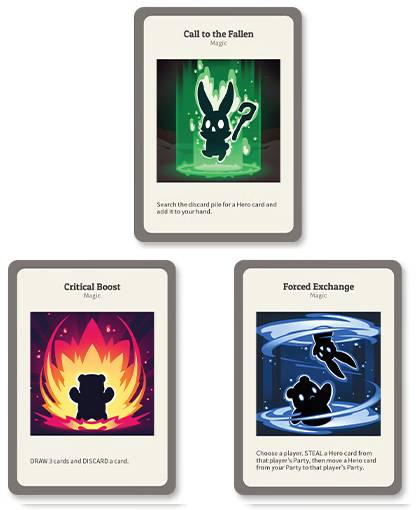
Magic cards are powerful spells with a one-time effect. After using a Magic card's effect, move it to the discard pile immediately.
Modifier Cards
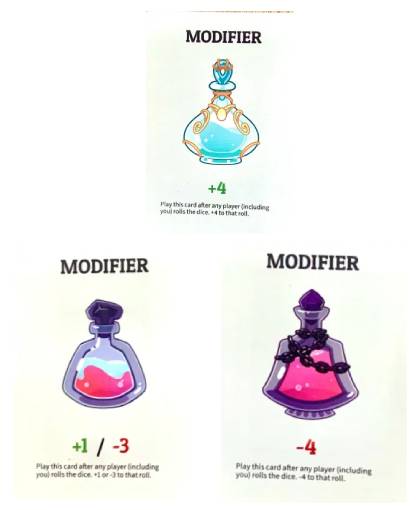
Modifier cards tip the odds in your favor. You can play a Modifier card instantly from your hand when any player (including you) rolls the dice, to modify the roll by the amount stated on the card. Playing a Modifier card does not cost any action points.
- Some Modifier cards give you two options (e.g., +1 or -3). Declare which option you wish to use.
- You may wait until a player chooses their targets (if applicable) before deciding to play your Modifier card.
- Each player may play any number of Modifier cards on the same roll. Once all players finish, combine the total change and adjust the roll accordingly.
Challenge Cards
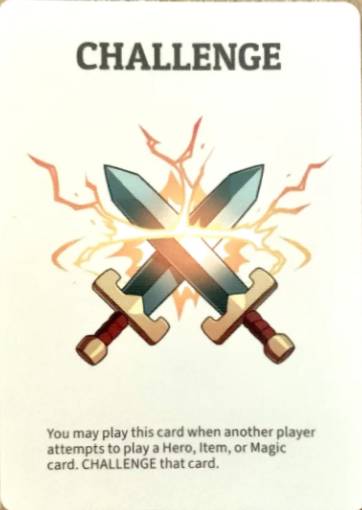
Challenge cards can be used to try to stop another player from playing a Hero, Item, or Magic card. Playing a Challenge card does not cost any action points.
- When you CHALLENGE another player, each of you rolls two dice.
- If your roll is equal to or higher than the other player's roll, you successfully prevent them from playing their card. That card is moved to the discard pile (and the player does not get back an action point).
- If the other player's roll is higher, they proceed with playing their card as planned.
- You may wait until both players have rolled before deciding whether to use a Modifier card.
- Each card can only be challenged once — if another player has already challenged the card, you may not challenge it a second time.
See also Party Leaders and Monsters for additional card types.
Party Leaders
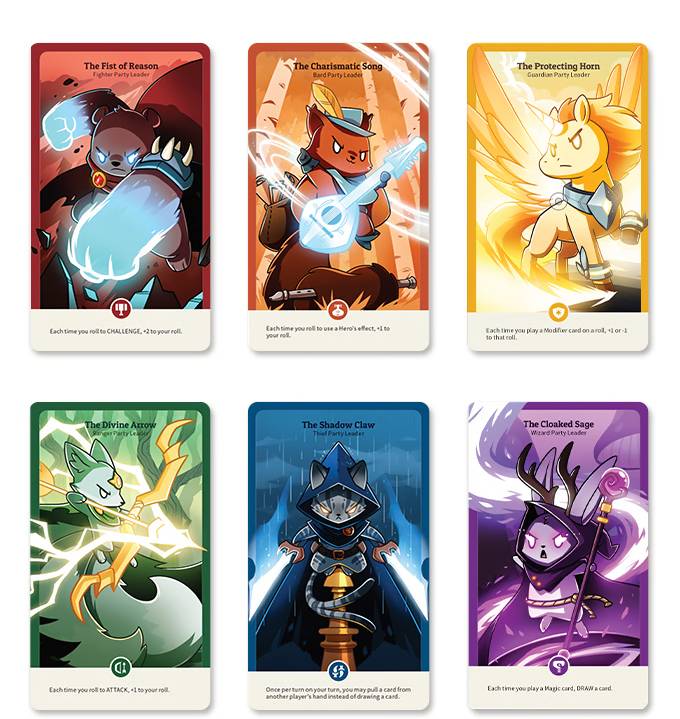
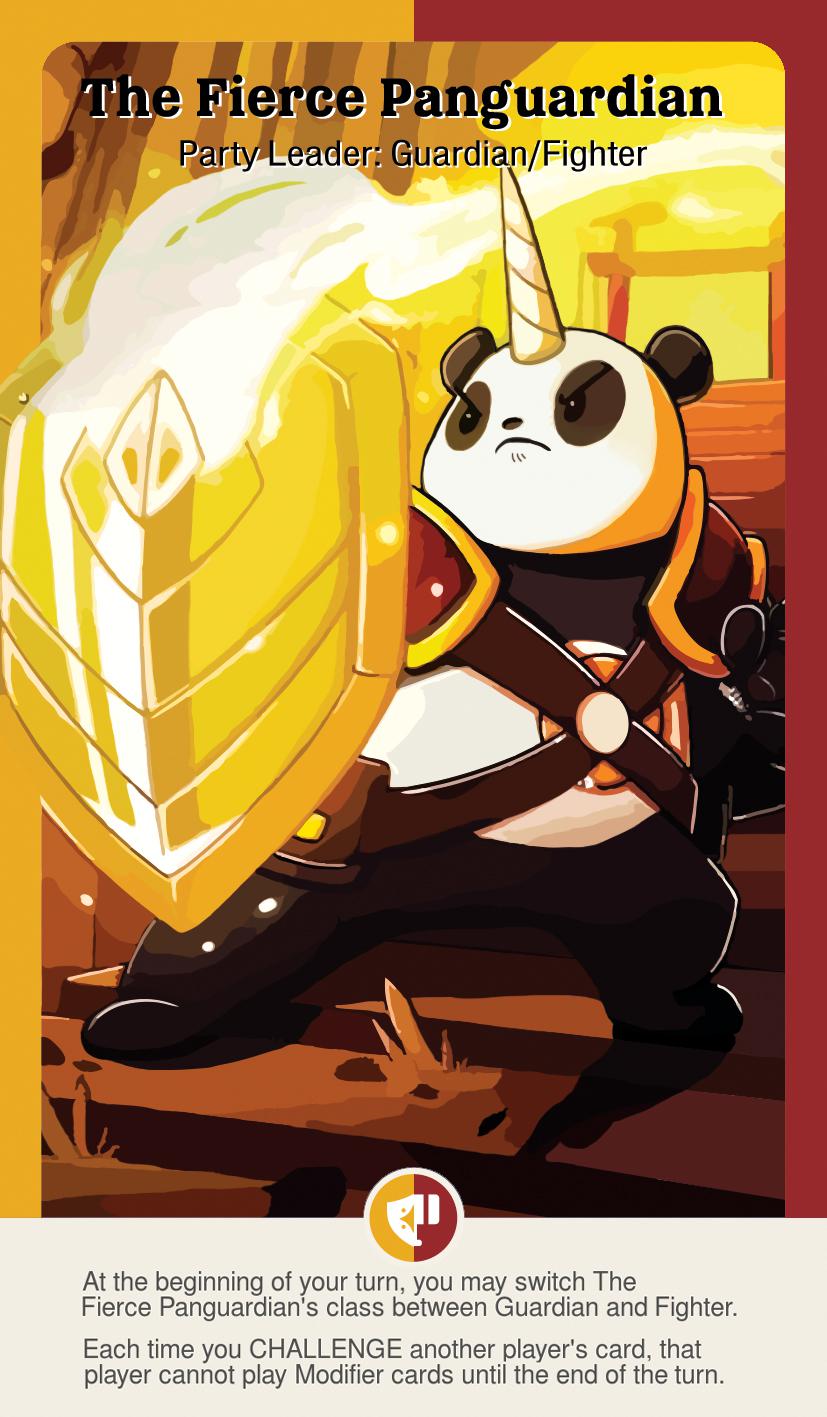
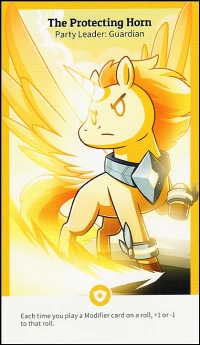
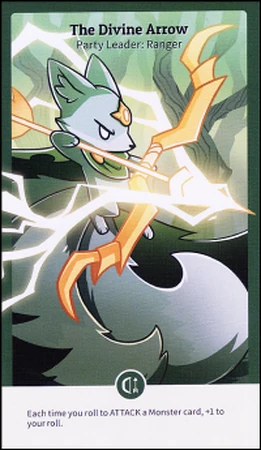
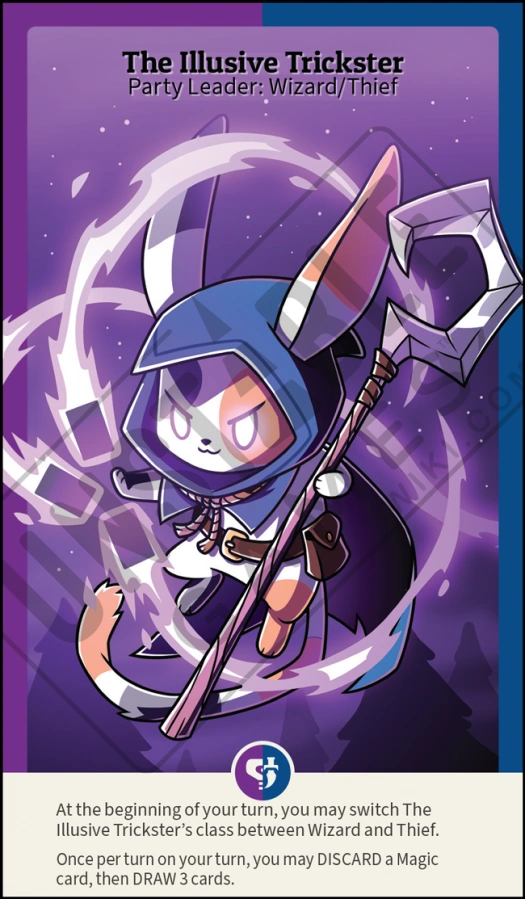
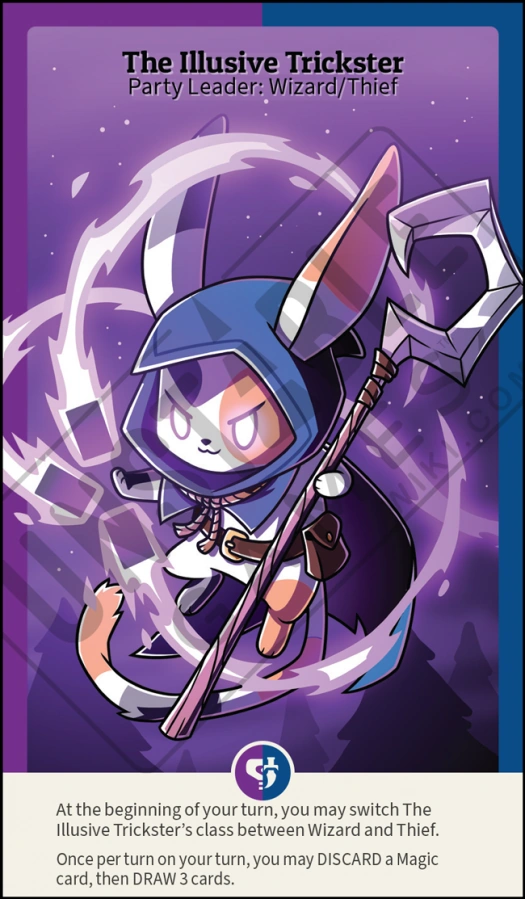
Party Leader cards are oversized cards with light-colored backs. Each Party Leader has a class and a skill that gives you a unique advantage throughout the game.
- Party Leader cards are not considered Hero cards.
- Unlike Hero card effects (which can only be used once per turn), your Party Leader's skill can be used each time its conditions are met.
- For example, if your Party Leader states "Each time you play a Magic card, DRAW a card," the skill triggers every time you play a Magic card, even multiple times per turn.
- If you don't use the skill at the time the condition is met, you cannot go back later and do it.
- Your Party Leader card remains in your Party for the entire game and cannot be sacrificed, destroyed, stolen, or returned to your hand.
Note: You may not use The Shadow Claw as your Party Leader card in 2-player games.
For details on Hero card abilities, see Card Types.
Monsters
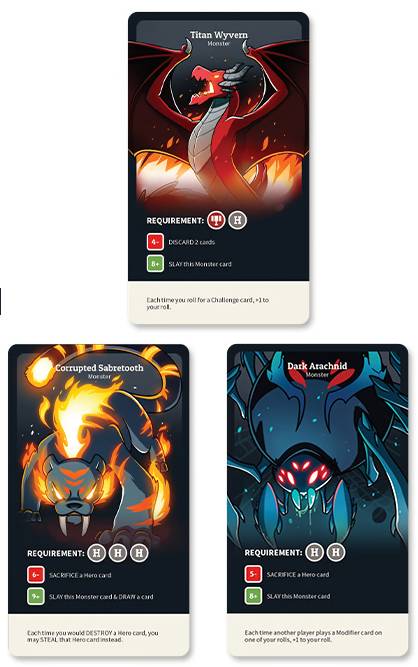
Monster cards are oversized cards with navy blue backs. On your turn, you can ATTACK any face-up Monster card in the center of the table for a cost of two action points.
Party Requirements
To ATTACK a Monster, you must first meet the Party requirements listed on that card. Some require a certain number of Hero cards in your Party, while others require specific classes. Your Party Leader card is not considered a Hero card and does not count toward Hero card requirements.
If a Monster card requires a specific class plus a Hero of "any class," a single Hero of that specific class can fulfill either requirement, but not both.
Rolling to Slay
Each Monster card has a roll requirement. Roll two dice:
- If you roll equal to or higher than the requirement (including Modifier cards), you SLAY the Monster!
- If you roll within the Monster's fight-back range, you must pay the penalty listed on the card (e.g., SACRIFICE a Hero card). The Monster remains unscathed.
- If your roll falls outside both ranges, nothing happens.
Regardless of the outcome, you do not get your action points back.
Slaying a Monster
When you SLAY a Monster:
- Add the slain Monster card to your Party next to your Party Leader card.
- Your Party gains the new skill listed at the bottom of the Monster card for the rest of the game. Monster card skills work like Party Leader skills.
- Monster cards in your Party cannot be stolen, destroyed, attacked, or returned to your hand.
- Flip another Monster card from the Monster deck face up in the center of the table.
Slaying three Monsters is one of the two win conditions.
How to Win
There are two ways to win the game:
- Option 1: SLAY three Monster cards.
- Option 2: End your turn with a full Party, meaning your Party (including your Party Leader card) represents six different classes.
Congratulations — you can officially brag that you are the best adventurer and monster slayer in the entire world!
Important Terms
Here is a list of key terms used in the game:
Set-Up Terms
- Party — The area in front of you in which you play Hero cards and Item cards.
- Main Deck — The stack of standard-sized cards from which players DRAW during the game.
- Discard Pile — The face-up stack of cards that have been sacrificed, destroyed, and discarded.
- Monster Deck — The stack of oversized cards from which a new Monster card is flipped face up each time a player SLAYS a Monster.
Gameplay Terms
- DRAW — Take the top card from the main deck and add it to your hand.
- DISCARD — Move a card from your hand to the discard pile.
- DESTROY — Move a card from another player's Party to the discard pile.
- SACRIFICE — Move a card from your own Party to the discard pile.
- STEAL — Move a card from another player's Party to your own Party.
- CHALLENGE — Attempt to stop another player from playing a Hero, Item, or Magic card. Both players roll dice; if the challenger's roll is equal to or higher, the card is discarded.
- ATTACK — Roll to SLAY a Monster card (costs 2 action points).
- SLAY — Add a Monster card that you successfully attacked to your Party.
Here are some tips to sharpen your adventuring skills:
- Balance your Party — Building toward six different classes gives you a second win condition. Even if you're focused on slaying Monsters, class diversity keeps opponents guessing.
- Save your Modifier cards — Don't waste Modifiers on low-stakes rolls. Keep them for crucial Monster attacks, Challenge defenses, or to sabotage opponents' key rolls.
- Time your Challenges — Challenge cards are limited. Use them to stop opponents from playing game-changing Hero or Magic cards, not minor plays.
- Use Hero effects wisely — Rolling to use a Hero's effect costs an action point even if you fail. Weigh the risk before spending your limited actions.
- Protect key Heroes — Equip Item cards that protect Heroes you need for Monster requirements or class completion.
- Cursed Items are powerful — Equipping a Cursed Item to an opponent's Hero can cripple their strategy. Time it for maximum disruption.
- Watch the Monster requirements — Before committing 2 action points to attack, make sure you can actually meet the roll requirement. A failed attack wastes your entire turn.
- Hand refresh is expensive — Discarding your entire hand to draw 5 costs all 3 action points. Only do this when your hand is truly dead weight.
If you enjoy strategic card games like Here to Slay, you might also like Pokémon TCG or Gin Rummy.
Here to Slay can be played with 2 players with the following adjustment:
- The Shadow Claw Party Leader card cannot be used in 2-player games.
All other rules remain the same. With only one opponent, Challenge cards and steal/destroy effects become even more impactful, and the race to six classes or three Monster slays is more direct.
Special Cards
Example Scenarios
Challenging a Hero Card
Attacking a Monster
Using a Hero Effect
Winning by Full Party
Frequently Asked Questions
No. Party Leader cards are not considered Hero cards. They do not count toward Monster card Party requirements that ask for a certain number of Hero cards. However, they do have a class and count toward the six-class win condition.
No. You can only attempt to use a Hero card's effect once per turn, even if your first roll was unsuccessful. You do not get the action point back on a failed roll.
No. Modifier cards and Challenge cards can be played instantly from your hand without spending any action points. Modifier cards can be played on any player's roll, and Challenge cards can be played on another player's turn when they attempt to play a Hero, Item, or Magic card.
No. Item cards can only be equipped to Hero cards, not to Party Leader cards.
If a Hero card with an equipped Item card is destroyed, stolen, or returned to your hand, the Item card goes along with it. The Item shares the same fate as the Hero it is equipped to.
No. Each card can only be challenged once. If one player has already challenged a card being played, no other player may challenge that same card a second time.
No. Only one Item card can be equipped to a Hero at a time, and you cannot replace it with another. The equipped Item must be removed (destroyed, discarded, etc.) before a new one can be equipped.
No. Unused action points do not roll over. Your turn ends when you run out of action points or choose to stop. You start each turn with a fresh set of three action points.
No. Monster cards in a player's Party cannot be stolen, destroyed, attacked, or returned to hand. Once slain, a Monster stays with the player permanently.
It depends on your roll. If your roll falls within the Monster's fight-back range, you must pay the listed penalty (e.g., SACRIFICE a Hero card). If your roll is between the fight-back range and the slay requirement, nothing happens. Either way, you do not get your 2 action points back.
No comments yet. Be the first to share your thoughts!